Creating a Successful Venture From Your Hobby
"You’ve got to rise above it if you consider yourself a professional. That’s the one thing that people don’t realize is that, yeah, what we do is what we love doing and wouldn’t trade it for the world, but at some point it can become work because you’re just not feeling good and people expect you to perform at your top level. And you’ve got to rise to the occasion. You can’t be a whiny brat and say, ‘I don’t want to do that.’” –Tony Hawk (Professional Skateboarder)
I was talking with some fellow pirate re-enactors about making money from our hobby. Many hobbyists spend a lot of time and money on their hobbies and it is often a dream to make rather than spend money on their pursuits. “Do what you love and the money will follow,” popular wisdom suggests. Of course, it’s not quite that simple. Chances are if you are involved in any hobby, you are one amongst many. Hobbies tend to attract people because they are enjoyable on a level that isn’t always found in what we think of as being “work.” Where there are a lot of people doing something for free, there isn’t likely to be much reason for people to pay for such a thing unless there is something unique and/or desirable about the way you do it. Success tip number one: if you want to turn your hobby into a money-maker, you have to find and cater to the market.
I recently met a couple who do make money being re-enactors. I saw their 17th/18th century clown act at a pirate re-enactment event. They appeared to make their living in this way. As I watched them, they dazzled the crowd with all sorts of period tricks and gags, frequently gathering a crowd of twenty to fifty people. I was happy to be working with five or ten people at any given time. Like the rest of the re-enactors, their food and accommodations had been covered by the event organizers, but they were also making money by selling some neat period magic tricks and soliciting donations after their show. Sounds simple, doesn’t it?
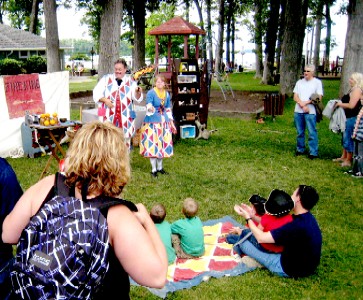
I discovered that they did in depth research on people who actually engaged in this trade during the era they were portraying. They spent a lot of time doing research in the era they portrayed, as well as learning and practicing their tricks. Just knowing the tricks wasn’t enough to get all those people to their display. They also made loud announcements about their upcoming show, threatening not to do it if there weren’t enough people along with cajoling those who were waiting for them to start. Once the show started, they incited the crowd with well-practiced patter, told bawdy jokes and did tricks with fire, juggling and similar exciting and potentially dangerous props. Success tip number two: to establish a good niche you have to research, practice and tailor your approach to get interest from potential buyers.
You may be thinking that this was all well and good for people who are extroverts and enjoy being “out there” and putting on a show. In fact, only one of the two seemed to be an extrovert; the other was rather quiet most of the time. You didn’t notice this on stage, however. While the extroverted individual was more willing to engage the people, the introvert did her part too. I suspect she knew that the only way they were going to make their living doing this was by moving out of her comfort zone and doing things she may not have naturally done. Success tip number three: most limitations are self-imposed; moving an activity from hobby to business requires stretching.
The pirate event had a lot of different activities going on; I know because I wandered off to see them. There was a pirate parade, a raucous pirates costume contest, a staged battle, cannon firing, demonstrations and vendors selling pirate-themed items. “Would you watch my stuff for me?” is a frequently asked question at events. However, I noticed the period clown duo rarely left their post while the event was going on. They even put on their show to a decent-sized crowd during the costume contest. I’m sure in the back of their minds they’d have liked to see all the stuff that was going on around them, but they probably also knew that this would mean missing an opportunity to perform. Success tip number four: in any venture, discipline is required to make it successful; the more focused your discipline the more successful your venture will be.
One way people try to turn a hobby or interest into a profitable venture is by writing books on their topic. I know dozens of people who are writing books, including me. Wayne Dyer tells of writing his first book Your Erroneous Zones which he wrote it in 18 days. When asked how he was able to do this, he explained that he took the concepts he had been teaching in university classes and suggesting to clients in his counseling sessions and put them into print. Those of you who write will recognize that it isn’t quite this simple, but that’s where the discipline comes in. Success tip number five: to successfully write about your interests, stick with a topic you know well and are involved with.
Dyer’s real work began when his book was published. His publisher printed 3500 copies of the book. According to Dyer, the publisher explained that it was “…a clever little title and a nice little book. If we sell the books that are on our list… then we’ll be happy, we’ll make a little money and you’ll make a little money....” Not satisfied, Dyer bought the entire first printing and stored it in his garage. The publisher produced a second printing of 1500 copies - which Dyer also bought. He then quit his job as a university professor and went on the road, traveling around the country to go on local morning radio shows dropping copies of the book at local book stores. As he said, “I was totally involved in the process.” He had to be. “I had 5000 books in my garage!” he explains with a laugh. In this way he got his book on the New York Times Best Seller List. Success tip number six: to make a venture successful you have to be fully invested and committed to seeing it though.
Have a great month!